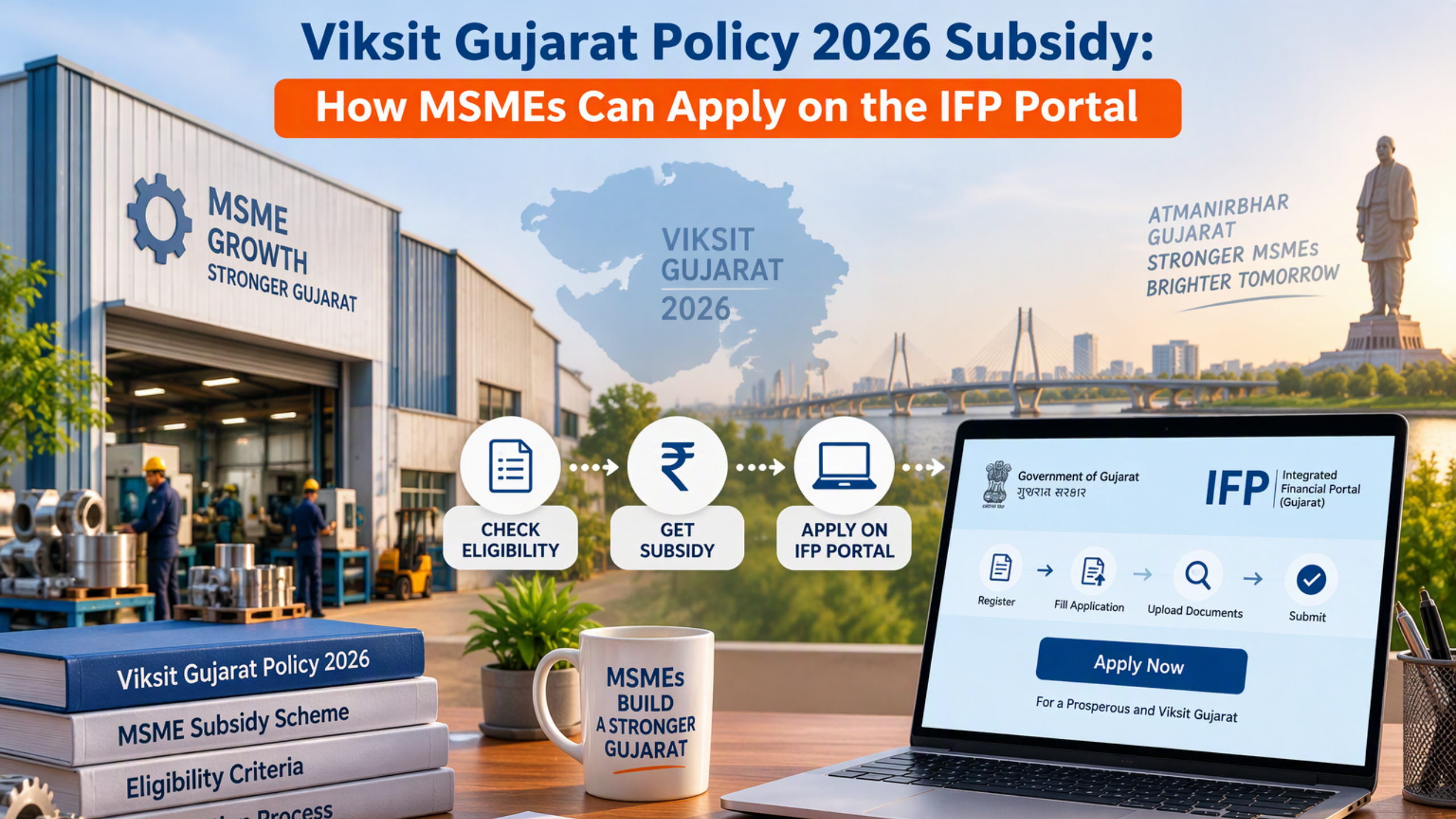
Can MSMEs apply for Viksit Gujarat Policy 2026 subsidies now? Yes. The Gujarat Government has opened online applications for Viksit Gujarat Industrial Policy 2026 incentives on the Investor Facilitation Portal (IFP). The MSME scheme covers 1 June 2026 to 31 May 2031. Eligible new and expanding manufacturing units can claim a capital investment subsidy of up to 35% (Category A) or 25% (Category B), plus interest and power tariff support. Combined assistance is capped at 45% (Category A) or 35% (Category B).
Introduction
If you plan to set up, expand, or modernise a manufacturing unit in Gujarat, the Viksit Gujarat Policy 2026 subsidy could reduce your project cost in a meaningful way. Applications are now being accepted through the IFP Portal, so the focus shifts from “when will it open” to “is my investment structured correctly to qualify”.
At Dinesh J. Shah & Associates, our Ahmedabad CA team handles subsidy eligibility checks, investment classification, CA certification, and application support for Gujarat manufacturers. This guide covers the incentives, the category-wise rates, who can apply, the documents you need, and the questions MSMEs ask most.
What Is Viksit Gujarat Policy 2026?
Viksit Gujarat Industrial Policy 2026 is the Gujarat Government’s industrial development policy. It encourages manufacturing investment and strengthens the state’s MSME ecosystem.
MSME scheme period: 1 June 2026 to 31 May 2031.
Who it covers: new manufacturing MSMEs and existing units undertaking eligible expansion or diversification.
Condition: all benefits depend on the prescribed eligibility conditions.
Types of Subsidy Under Viksit Gujarat Policy 2026
Incentive
What it offers
Capital Investment Subsidy
Assistance on eligible fixed capital investment, based on unit category, location and prescribed limits
Interest Subsidy
Interest assistance on eligible term loans from banks or recognised financial institutions
Power Tariff Subsidy
Assistance on eligible electricity consumption for the prescribed period
Employment Generation Assistance
Reimbursement of eligible employer EPF contributions for new employees
Other MSME Incentives
Support for quality certification, patent registration, technology acquisition, rent, CGTMSE fees and other specified activities
Category-Wise MSME Subsidy Rates
Incentive
Category A
Category B
Capital Investment Subsidy
35%
25%
Interest Subsidy
7%
7%
Power Tariff Subsidy
₹2 per unit
₹1 per unit
Combined Assistance Ceiling
45%
35%
These are general-sector headline rates. Component-wise ceilings, annual limits, duration and eligibility conditions apply. Selected thrust sectors have separate enhanced provisions.
Who Can Apply for the Gujarat MSME Subsidy?
New manufacturing MSMEs setting up units in Gujarat
Existing manufacturing units undertaking expansion
Track and respond. Keep records ready for any department queries.
Documents Required for Subsidy Application
The exact list depends on the incentive you claim.
Udyam Registration Certificate
GST Registration Certificate
PAN Card and constitution documents
Land ownership documents or lease deed
Building and construction details
Plant and machinery invoices
Bank statements and payment proofs
Chartered Accountant certificate for eligible investment
Electricity connection documents
Commencement of production evidence
Bank account details and cancelled cheque
Other documents prescribed under the applicable scheme
Properly classified investment records are what establish your eligible investment, so verify them before you submit.
Frequently Asked Questions
Are Viksit Gujarat Policy 2026 subsidy applications open? Yes. The IFP Portal application facility has been announced as open. Check your scheme category and the current portal instructions before applying.
Is a bank loan compulsory for the capital investment subsidy? No. Under the general MSME provisions, a term loan is not automatically mandatory for the capital subsidy. The interest subsidy, however, has separate term-loan eligibility requirements.
Can existing manufacturing units get the subsidy? Yes, existing units can qualify under the expansion or diversification provisions, subject to the prescribed conditions.
Can a unit in leased premises apply? A lease does not automatically disqualify a unit. The lease documents and investment conditions need to be examined.
Is second-hand machinery eligible for subsidy? No. Second-hand machinery is not eligible under the applicable provisions.
What is the maximum combined subsidy for MSMEs? Under the general provisions, the combined assistance ceiling is 45% for Category A and 35% for Category B. Component-wise limits and thrust-sector provisions may differ.
Where do I submit the application? Applications can be initiated on the official Gujarat Government IFP Portal: https://gsws.gujarat.gov.in/
Need Help With Your Subsidy Application?
Planning a new unit, an expansion, or a machinery purchase in Gujarat? Dinesh J. Shah & Associates, Chartered Accountants in Ahmedabad, can check your eligibility, structure your investment records, and manage your Viksit Gujarat Policy 2026 subsidy application end-to-end.
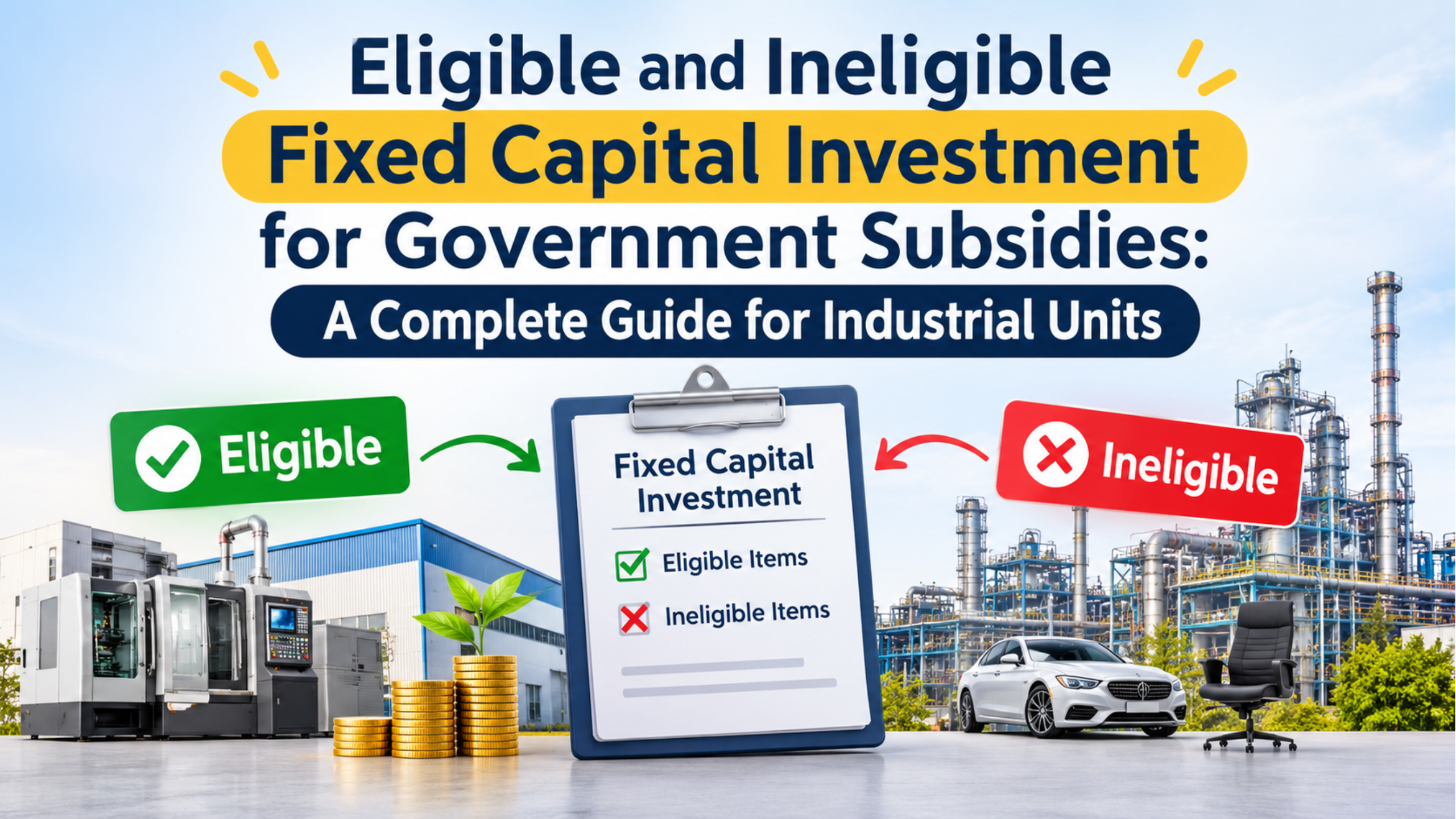
Eligible Fixed Capital Investment (FCI) generally includes new buildings, other eligible construction, new plant and machinery, and project-related infrastructure. Ineligible FCI generally includes land, working capital, goodwill and royalty, pre-operative expenses, second-hand machinery, capitalised interest and leased assets. Exact rules depend on the applicable Government Resolution (GR).
When setting up or expanding a manufacturing unit, knowing which investments qualify for subsidy is a core part of project planning. Under most industrial incentive schemes, assistance is calculated on eligible Fixed Capital Investment, but not every expense you incur counts. Identifying eligible and ineligible Fixed Capital Investment correctly is essential when preparing your Detailed Project Report (DPR), finalising project cost and planning a subsidy application.
In this guide, Dinesh J. Shah & Associates explains the major components of eligible and ineligible Fixed Capital Investment and what to check before you invest.
What Is Fixed Capital Investment (FCI)?
Fixed Capital Investment is the investment made in specified fixed assets to establish, expand, modernise, or diversify an industrial unit. Depending on the applicable policy, eligible FCI may include:
New building construction
Other eligible construction
New plant and machinery
Project-related infrastructure
Definitions and conditions differ between schemes, so always read the applicable GR and scheme guidelines before calculating eligible investment.
Eligible Fixed Capital Investment: What Qualifies?
The components below may qualify for consideration under applicable industrial incentive schemes, subject to the prescribed conditions.
New Building
A newly constructed industrial building used for eligible manufacturing activity may qualify. Example: a new factory shed built to house production machinery.
Other Construction
Certain construction expenses directly linked to the industrial project may be considered, depending on the policy. Check whether the scheme lists the specific construction types it accepts.
New Plant and Machinery
New plant and machinery needed for manufacturing is usually the largest component of eligible FCI. Example: new production lines, processing equipment, and other eligible manufacturing equipment.
Project-Related Infrastructure
Infrastructure developed specifically for the project may qualify under the scheme’s definitions and conditions. Check the scheme’s infrastructure definition before including it in your DPR.
Important: An expense in an eligible category does not automatically qualify. You must also examine its nature, purpose, ownership, payment proof, and compliance with the policy.
Ineligible Fixed Capital Investment: What Is Excluded?
Certain expenses are excluded when calculating eligible FCI under the scheme provisions.
Land and Land Development Cost
The purchase cost of land and land development expenses are generally excluded. Example: buying the plot for your factory.
Working Capital
Day-to-day operating needs are not FCI. Examples: raw materials, inventory, salaries and wages, electricity, and other routine expenses.
Goodwill and Royalty
Payments for goodwill and royalty are excluded under the stated criteria.
Preliminary and Pre-Operative Expenses
Costs incurred before commercial operations begin are excluded under the stated criteria.
Second-Hand Plant and Machinery
The cost of second-hand plant and machinery is excluded, whether bought domestically or imported. Example: a used CNC machine purchased from another unit.
Capitalised Interest
Interest on loans or borrowings capitalised into project cost is excluded.
Rented or Leased Assets
Assets acquired on rent or lease, including buildings, are excluded.
Power Generation Plant
Power generation facilities are generally excluded, except qualifying captive consumption facilities where the policy specifically permits.
Renewable Power Plants for Third-Party Sale or Non-Captive Use
Renewable power facilities built to sell electricity to third parties or for non-captive use are excluded.
Design, Drawing, Consultancy, Supervision and Third-Party Inspection Fees
These are excluded where they do not qualify under the scheme’s technology acquisition provisions. Always verify treatment against the relevant GR.
Eligible vs Ineligible Fixed Capital Investment: Quick Comparison Table
Investment category
Status
What to check
New building
Eligible, subject to conditions
Used for eligible manufacturing activity
Other construction
Eligible, subject to conditions
Listed construction types in the GR
New plant and machinery
Eligible, subject to conditions
Must be new, with purchase invoices and payment proof
Project-related infrastructure
Eligible, subject to conditions
Scheme’s infrastructure definition
Land and land development
Ineligible
Keep outside the FCI claim
Working capital
Ineligible
Separate from fixed asset records
Goodwill and royalty
Ineligible
Exclude from project cost for subsidy
Preliminary and pre-operative expenses
Ineligible
Exclude from project cost for subsidy
Second-hand plant and machinery
Ineligible
Applies to domestic and imported
Capitalised interest
Ineligible
Exclude if capitalised into project cost
Rented or leased assets
Ineligible
Includes leased buildings
Power generation plant
Generally ineligible
Captive-use exception, if the policy allows
Renewable power plant (third-party or non-captive)
Ineligible
Check captive vs sale purpose
Design, consultancy and inspection fees
Ineligible unless qualifying technology acquisition
Check technology acquisition provisions
Why Is Correct FCI Classification Important?
Classifying eligible and ineligible Fixed Capital Investment correctly helps in five ways:
Accurate subsidy estimation: you see which investment may attract assistance.
Proper DPR preparation: project cost is presented in a structured, transparent way.
Better financial planning: you know eligible investment before finalising spend.
Proper documentation: invoices, payment proofs, bank statements and asset records stay organised.
Fewer application discrepancies: you avoid including expenses that don’t qualify.
Documents Required for Fixed Capital Investment Verification
Depending on the scheme and project, keep the following ready:
Detailed Project Report (DPR) and project cost statement
Building construction bills and invoices
Plant and machinery purchase invoices
Bank statements showing payments to suppliers
Fixed asset register and machinery ledger
Loan sanction letters and disbursement details, where applicable
Technical details of machinery and project infrastructure
Other declarations and certificates prescribed under the scheme
Maintaining these from day one reduces difficulty during application and verification.
Conclusion
Understanding eligible and ineligible Fixed Capital Investment is a key step before setting up or expanding an industrial unit. New buildings, eligible construction, new plant and machinery, and project-related infrastructure may qualify, while land, working capital, second-hand machinery, capitalised interest, and other excluded costs must be assessed separately. Planning a subsidy application? Speak to Dinesh J. Shah & Associates to classify your project cost correctly before you invest.
Frequently Asked Questions
What is Fixed Capital Investment (FCI)? Fixed Capital Investment is the investment in specified fixed assets, such as buildings, plant and machinery, made to establish, expand, modernise or diversify an industrial unit. Subsidy is generally calculated on the eligible portion of FCI under the applicable government scheme.
Is land cost included in eligible Fixed Capital Investment? Generally no. The purchase cost of land and land development expenses are excluded under the stated eligibility criteria. Confirm against the applicable GR for your scheme.
Is second-hand machinery eligible for subsidy? No. The cost of second-hand plant and machinery, whether purchased domestically or imported, is excluded under the stated criteria. Only new plant and machinery generally qualifies.
Is working capital part of Fixed Capital Investment? No. Raw materials, inventory, salaries, and routine operating expenses are working capital and are excluded from eligible FCI.
Does an eligible category guarantee subsidy? No. Nature, purpose, ownership, payment proof, and policy compliance are also examined, so the expense must meet the scheme’s conditions.
Which documents are needed to verify eligible FCI? Typically, the DPR, project cost statement, construction and machinery invoices, supplier payment bank statements, and fixed asset register, plus any scheme-specific declarations.
As per GR No. IMD/HMR/e-file/9/2026/2211/I Section dated 8 September 2026, the Gujarat Government has classified 130 talukas as Category A and 138 talukas as Category B across 34 districts under the Viksit Gujarat Industrial Policy 2026. The full district-wise list is below.
The Industries & Mines Department, Government of Gujarat, has notified the revised classification of talukas for various incentive schemes under the Viksit Gujarat Industrial Policy 2026.
Vide Resolution No. IMD/HMR/e-file/9/2026/2211/I Section, approved on 8 September 2026, the Government has classified talukas into Category A and Category B for incentives under the policy. The revised classification has been made considering the provisions of the new Industrial Policy and the creation of new talukas in Gujarat.
The GR states a total of 130 Category A and 138 Category B talukas.
Complete District-Wise Category A & Category B Taluka List
The following classification is as notified in Annexure-A of the Government Resolution.
No.
District
Category A Talukas
Category B Talukas
1
Ahmedabad
Dholera, Detroj-Rampura, Dhandhuka
Viramgam, Daskroi, Bavla, Dholka, Sanand, Mandal, Ahmedabad City
The complete classification is contained in Annexure-A of the GR across pages 2 to 6.
Why This Classification Matters for Businesses
The Viksit Gujarat Industrial Policy 2026 Update taluka classification is important for entrepreneurs and industrial units planning:
● New manufacturing projects
● Expansion of existing units
● Diversification
● Modernisation
● New investment in Gujarat
● Relocation or selection of a project location
The location of an industrial project can have an important bearing on the incentives available under the applicable scheme. However, Category A or Category B classification alone does not automatically establish incentive eligibility. The GR clearly provides that the applicable incentive package will be governed by the respective scheme’s provisions, eligibility criteria, and other terms and conditions.
What Should an Investor Check Before Finalising a Project Location?
Before purchasing land, taking premises, or committing substantial capital investment, an industrial unit should evaluate:
Taluka Classification: check whether the proposed project location falls under Category A or Category B
Enterprise Category: determine whether the unit qualifies as MSME, Large, Mega, Ultra-Mega, or another applicable category under the policy
Nature of Investment: identify whether the proposal is a new unit, expansion, diversification, or modernization
Eligible Investment: determine the investment that qualifies for incentives under the respective scheme
Applicable Incentive Scheme: review the specific subsidy/incentive available to the proposed project
Eligibility Conditions: check investment, production, employment, commencement, and other conditions prescribed under the relevant scheme
Financing Structure: assess term loan, working capital and promoter contribution requirements alongside the subsidy/incentive structure
Not sure which Taluka category your unit falls under, or how much subsidy you could claim? Contact SDS Fin Advisory LLP for a free eligibility check.
Frequently Asked Questions
Q1. How many talukas are Category A and Category B under the Viksit Gujarat Industrial Policy 2026?
As per GR No. IMD/HMR/e-file/9/2026/2211/I Section dated 8 September 2026, there are 130 Category A talukas and 138 Category B talukas across Gujarat’s 34 districts.
Q2. Does Category A or Category B classification alone decide my subsidy eligibility?
No. Taluka classification affects the subsidy ceiling available, but actual eligibility is governed by the applicable scheme’s own provisions, enterprise category, investment type, and eligibility conditions.
Q3. Where can I find the official list of Category A and Category B talukas in Gujarat?
The complete district-wise classification is notified in Annexure-A of GR No. IMD/HMR/e-file/9/2026/2211/I Section, dated 8 September 2026, issued by the Industries & Mines Department, Government of Gujarat.
The Viksit Gujarat MSME Subsidy Scheme 2026 (GR dated 25 September 2026, policy period 1 June 2026 to 31 May 2031) gives Micro, Small and Medium enterprises capital subsidy, interest subsidy and power tariff support of up to 45% of eligible investment in general sectors and up to 50% in selected thrust sectors, over 5 years, depending on taluka category.
The Viksit Gujarat Industrial Policy 2026 includes a dedicated Assistance Scheme for MSMEs, notified vide GR dated 25 September 2026, applicable for the policy period 1 June 2026 to 31 May 2031. The scheme supports Micro, Small and Medium Enterprises in Gujarat with capital & interestsubsidy, power tariff support, and a range of additional incentives.
This guide summarises who can apply, how MSME investment slabs work, what’s eligible and ineligible for subsidy, the subsidy benefit structure for general and selected thrust sectors, and the PEC/FEC application timeline.
Key Highlights
• Policy period: 1 June 2026 to 31 May 2031 (GR dated 25 September 2026)
• MSME slabs: Micro up to ₹2.50 crore, Small up to ₹25 crore, Medium up to ₹125 crore in Plant & Machinery
• Overall subsidy ceiling: up to 45% (general sectors) or 50% (selected thrust sectors) of eligible investment over 5 years
• Term loan must be from a bank or RBI-recognised financial institution — NBFC loans are not eligible
• +1% additional interest subsidy for women-owned, first-generation and startup enterprises
Who Can Apply for the Viksit Gujarat MSME Subsidy Scheme?
Eligible applicants include companies, partnership firms (including LLPs), societies, trusts, industrial co-operative societies, and proprietary concerns engaged in, or proposed to be engaged in, manufacturing, production, processing, or job work of articles.
Category
Plant & Machinery Investment
Micro
Up to ₹2.50 crore
Small
More than ₹2.50 crore and up to ₹25 crore
Medium
More than ₹25 crore and up to ₹125 crore
For MSME classification under this scheme, Gross Fixed Capital Investment in Plant & Machinery across all units in India is considered — not just the Gujarat unit.
Can You Choose the Previous Scheme Instead of the 2026 Scheme?
•Production before 1 June 2026: previous scheme only.
•Production on or after 1 June 2026: applicant can choose the previous scheme or the 2026 scheme.
If the previous scheme is chosen:
• Application must be submitted within 6 months from the GR date.
• The option, once exercised, is final and irrevocable.
• After 6 months, applications will be considered only under the 2026 scheme.
• Commercial production must commence on or before 4 October 2027 to avail the previous scheme’s benefits.
For the 2026 scheme, eligible fixed capital investment under the applicable provision covers assets acquired and paid for from 1 January 2026, subject to the scheme conditions.
New Enterprise, Expansion or Diversification — How Are They Defined?
New Enterprise
A new MSME commencing commercial production during the operative period. Any new or existing unit that undertakes expansion or diversification at a premises other than its existing premises is also treated as a ‘New Unit’.
Existing Enterprise
An enterprise already in production before the expansion or diversification begins.
Expansion
• Investment at the same premises must increase existing GFCI (excluding land) by at least 50%.
• At least 60% of that investment must be in Plant & Machinery.
• Installed capacity must increase by at least 50%.
• Existing capacity utilisation must have reached at least 75% in any one of the preceding three financial years.
• The project is eligible only after one year from Project Completion of the existing unit, or one year from its DoCP, whichever is later.
Diversification
• Investment at the same premises must increase existing GFCI by at least 25% for Micro/Small and at least 50% for Medium enterprises.
• At least 60% of that investment must be in Plant & Machinery.
• Power generation plant, except for captive use within the premises
• Renewable power plant for third-party sale or non-captive use
• Design/drawing, consultancy, supervision and third-party inspection fees without technology acquisition
What Is the Eligible Fixed Capital Investment Period?
Gross Fixed Capital Investment (GFCI)
Eligible Investment Period
Up to ₹50 crore
12 months from DoCP
More than ₹50 crore up to ₹125 crore
18 months from DoCP
• Assets acquired and paid for from 1 January 2026 can be considered, subject to the scheme conditions.
• The enterprise must commence commercial production during the operative period.
• MSME status is decided as on the date of project completion.
What Subsidy Benefits Do MSMEs Get in Gujarat?
Benefits combine capital subsidy, interest subsidy and power tariff support, subject to an overall ceiling of eligible investment over 5 years. Location matters: Category A talukas receive the higher slab, Category B the lower. The term loan must be from a bank or RBI-recognised financial institution — NBFC loans are not eligible for subsidy.
Within 6 months from DoCP or 6 months from GR date, whichever is later
Entire investment completed on DoCP
Direct FEC
Within the time limit prescribed above
Entire investment completed within eligible period
Direct FEC
Within 6 months from project completion or 6 months from GR date, whichever is later
Investment not completed within eligible period
FEC
Within 6 months from the last date of the eligible investment period
PEC not filed in time
Direct FEC
Within the respective prescribed FEC time limit
Delayed FEC within 2 years
Delayed FEC
Delayed incentive period
Beyond 2 years
—
Not entertained
DoCP – Date of Commercial Production PEC – Provisional Eligibility Certificate FEC – Final Eligibility Certificate GR – Government Resolution
Time-sensitive: for units producing on or after 1 June 2026, the 6-month PEC/FEC window measured from the GR date points to 25 March 2027 (6 months from the 25 September 2026 GR). Confirm the exact deadline for your case before it passes.
Key Takeaways
• The Viksit Gujarat MSME Subsidy Scheme runs from 1 June 2026 to 31 May 2031, under a GR dated 25 September 2026.
• MSME status depends on Plant & Machinery investment: Micro up to ₹2.5 crore, Small up to ₹25 crore, Medium up to ₹125 crore.
• Subsidy combines capital subsidy, 7% interest subsidy and power tariff support, capped at 35%–50% of eligible investment depending on taluka category and sector.
• Only bank/RBI-recognised FI term loans qualify — NBFC loans are excluded.
• PEC/FEC filing deadlines are strict; a delayed FEC beyond 2 years is not entertained.
Frequently Asked Questions
What is the Viksit Gujarat MSME Subsidy Scheme 2026?
It is the Assistance Scheme for MSMEs under the Viksit Gujarat Industrial Policy 2026, notified vide GR dated 25 September 2026, applicable for the policy period 1 June 2026 to 31 May 2031. It offers capital subsidy, interest subsidy, power tariff support and other incentives to eligible Micro, Small and Medium enterprises in Gujarat.
Who is eligible for the Viksit Gujarat MSME subsidy?
Companies, partnership firms including LLPs, societies, trusts, industrial co-operative societies and proprietary concerns engaged or proposed to be engaged in manufacturing, production, processing or job work of articles, and classified as Micro, Small or Medium based on Plant & Machinery investment, can apply.
What are the MSME investment limits under the 2026 scheme?
Micro: up to ₹2.50 crore in Plant & Machinery. Small: more than ₹2.50 crore up to ₹25 crore. Medium: more than ₹25 crore up to ₹125 crore. Gross Fixed Capital Investment in Plant & Machinery across all units in India is considered for classification.
How much subsidy can an MSME get under Viksit Gujarat Industrial Policy 2026?
For general MSME sectors, the overall ceiling is up to 45% of eligible investment in Category A talukas and 35% in Category B, over 5 years. For the 5 selected thrust sectors (sports goods, toys, footwear, robots, drones), the ceiling rises to up to 50% in Category A and 45% in Category B.
Is a loan from an NBFC eligible for the MSME subsidy?
No. The scheme requires the term loan to be from a bank or an RBI-recognised financial institution. Loans from NBFCs are not eligible for the subsidy.
What is the application timeline for PEC and FEC under the MSME scheme?
After the Date of Commercial Production (DoCP), if investment is not fully completed, an application for a Provisional Eligibility Certificate (PEC) must be filed within 6 months from DoCP or 6 months from the GR date, whichever is later. A Final Eligibility Certificate (FEC) follows once the project and investment are complete, and a delayed FEC is allowed up to 2 years with a delayed incentive period.
Can an existing MSME apply for subsidy on expansion or diversification?
Yes. For expansion, Gross Fixed Capital Investment at the same premises (excluding land) must rise by at least 50%, with at least 60% in Plant & Machinery, and installed capacity must increase by at least 50%, with prior utilisation of at least 75% in one of the preceding three years. For diversification, GFCI must rise by at least 25% for Micro/Small and 50% for Medium units, with at least 60% in Plant & Machinery.
Need help checking your eligibility or filing the PEC/FEC application?
The Ministry of Micro, Medium, and Small Businesses (MSME) has been affected by the unusual situation caused by COVID-19 and the resulting lockdown. The Small Industries Development Bank of India (SIDBI) has launched the TWARIT (Timely Working Capital Assistance to Revitalize Industries in Times of Corona Crisis) Scheme to help MSMEs stay afloat during the crisis. The SIDBI intends to provide relaxation to the MSME sector as part of this Program by offering 20percent of overall outstanding loans up to INR 25 crore. The TWARIT Scheme of SIDBI is defined in detail in this article.
Timely Working Capital Assistance to Revitalize Industries in Times Of Corona Crisis, as previously mentioned, is a unique solution to the extraordinary situation created by the COVID-19 pandemic. The Timely Working Capital Assistance to Revitalize Industries in the Times of Corona Crisis Scheme aims to provide much-needed assistance to MSME units whose operations have been harmed by COVID 19.
ELIGIBILITY CRITERIA FOR THE SCHEME
Panhandler accounts must be less than or equivalent to 2 months past due as of February 29, 2020, to qualify for the TWARIT scheme.
To be eligible for the Program, all active applicant accounts, including those under Credit Delivery Arrangement, must total ₹25 crores in outstanding credit facilities as of 29-Feb-2020.
Existing clients on the Bank’s records are eligible for the TWARIT Scheme.
To benefit from the TWARIT scheme, the MSME must be GST certified in all instances; however, this requirement does not apply to organizations that are not required to register for GST.
The entity’s turnover must be at least ₹25 crores to qualify for the payout in the FY 2019-20.
The qualifying individual will be given an opt-out option under the TWARIT program, allowing them to choose whether they are interested or not in choosing the program.
The Scheme will be available to all applicants who have not been listed as Special Mention Accounts (SMA 2) or Search Queries Non-Performing Asset (NPA) by several of the Member Lending Institutions (MLIs) as of February 29, 2020.
BENEFITS OF THE SCHEME
The applicant would have a four-year loan repayment period with a one-year moratorium under the TWARIT Scheme.
The TWARIT pre-payment scheme does not include any penalties for the customers.
MSME units do not have to pay any organizer’s contribution to secure a loan under this SIDBI Program.
There is no cost to apply for a loan through the TWARIT program.
SECURITY UNDER THE SCHEME
Under the TWARIT program, SIDBI makes the addition of charges on the Primary Safety or Conditional Safety.
In case of cash flows and safety, the additional Working Capital Term Loan facility issued under TWARIT would be placed second behind current credit facilities, with a fee on assets funded under the TWARIT Scheme to be generated within three months of loan disbursement.
Under this SIDBI Program, no extra collateral would be needed for additional financing.
RATE OF INTEREST
8.25 percent per annum standard rate with yearly reset.
TENURE
The loan scheme has a four years term.
FEE FOR APPLICATION PROCESSING
SIDBI will not charge an extra charge because additional credit under TWARIT is given to current customers, as previously stated.
SCHEME PROCEDURE FOR APPLICATION
The TWARIT scheme includes an automatic pre-approval process, eliminating the need for the borrower to notify the SIDBI for a loan. SIDBI will send qualifying applicants an offer letter for a preapproved loan, which they may approve or disapprove. If the MSME approves the bid, the applicant must complete the required paperwork.
A different account for the loan will be there for the applicant as part of this Program for the possibility of raising additional credit. This new account would be different from the consumer’s current loan account.
The scheme aims to provide financial Assistance by Term loan to the existing MSME units who want to undertake expansion/modernization/capital expenditure in the same line of business by way of purchase of land, construction of factory building, Purchase of equipment, Plant & Machinery and Misc. Fixed assets, Installation of Rooftop Solar Projects, Acquisitions of other energy efficiency devices. This scheme is valid up to 31st March 2022 and may be extended on a need basis.
Eligible Criteria:-
Financial assistance shall be provided to Micro, small and medium enterprises engaged in high growth and priority sectors (including sunrise sector), thrust sectors for undertaking expansion/modernization/capital expenditure.
Brownfield enterprises having a minimum of 2 Years of operation and Audited accounts for at least two full years are eligible under the ARISE scheme.
There must be cash profits in the last audited financial results.
List of Eligible Sectors under ARISE scheme
Automobiles (excluding dealership)
Automobile Components (include general Engg.)
Medical Equipment, healthcare and hospitals, and Nursing homes and Diagnosting Centers
Chemicals and Chemical products
Paper & Paper Products (include Printing)
Renewable Energy including Rooftop solar Projects
Electronic systems
Electrical Machinery
Rubber and Plastic
Food Processing
Textile and Garments
Ceramics and Stone Processing
Iron and steel
Drugs and Pharmaceuticals
Biotechnology
Aerospace& Defence
MSME setting their projects other than the above-mentioned sectors may also allow being covered under the scheme subject to the approval of RO In- charge.
Quantum of Assistance:
Term loan up to Rs. 500 Lakh per borrower subject to a maximum of80 % of the project cost shall be allowed.
For smaller loans up to Rs. 3 crore for machinery/ equipment finance, 100% of the project cost shall be allowed.
Higher term loan for plant & machinery, purchase of land, construction of factory building, etc. up to Rs. 700 lakh to one borrower can be allowed subject to the approval of RO In-charge.
Promoters have to contribute a minimum of 20% of the project cost. In case of loans up to Rs. 3 crore on machinery/equipment where 100% financing is proposed, cash collateral up to 25% of project cost on the lines of SPEED scheme shall be applicable.
Interest rate and Repayment:
Interest rate will be 5.50 % to 6.80 % p.a for the first year. From the next years, it will be as per internal rating.
Repayment up to 7 years including moratorium up to 2 Years.
Conclusion:
This scheme is to promote existing MSME engaged in high growth and priority sectors for undertaking Expansion/modernization projects. The main benefits of the schemes are attractive ROI, 80% finance of project cost, maximum subsidy benefit, lowest security requirement, and quick sanction. MSME who wants machinery finance for their expansion project can avail 100% financing up to Rs. 3.00 Crore with an attractive rate of interest.
M/s Dinesh J. Shah & Associates is a practicing CA firm in Ahmedabad in the field of Taxation, GST, Audit, Project Finance, and Government Subsidy for more than 20 years. If you have any queries, feel free to contact us on 9825373707 or mail at info@djshahca.com or officeidk@gmail.com
The STHAPAN Scheme aims to promote capital investments in the MSME sector by assisting Greenfield Manufacturing units. It provides financial assistance by way of term loan for plant & machinery, purchase of land, construction of factory building, purchase of equipment, Misc. fixed assets, installation of rooftop solar projects, etc. under the product-linked incentive schemes. This scheme is valid up to 31st March 2022 and may be extended on a need basis.
Eligibility Criteria:
The main objective of STHAPAN is to provide financial assistance toGreenfield units for setting up new units.
The Promotersof new entity should have 5 years of experience in the business.
List of sectors under STHAPAN Scheme
Automobiles and Auto Components (excluding dealership but including general Engg.)
Specialty Steel
White Goods (including ACs and LEDs)
Textile Products: MMF Segment and technical textiles
High-efficiency solar PV modules
Advanced Chemistry Cell (ACC) Battery
Drugs and Pharmaceuticals(including ingredients)
Food Products
EV Charging Stations
Medical devices
Healthcare Centers (including Hospitals, nursing homes, and diagnostic centers)
MSMEs projects other than the above-mentioned sectors may also be allowed to be covered under the scheme subject to in-principle approval from RO In-charge.
Quantum of Assistance:
Term Loan up to Rs.1500 Lakh per unit/ borrower, subject to a maximum of 75% of the project cost.
Higher Term loan for plant& machinery, purchase of land and construction of the building, etc. up to Rs.2000 Lakh to one unit shall be subject in-principle approval as per Loan Policy.
Promoters have to contribute a minimum of 25% of the project cost.
Interest rate and Repayment:
Interest rate will be 6.00 % to 7.30 % p.a for the first year. From the next years, it will be as per internal rating.
Repayment up to 7 years including moratorium up to 2 Years.
Conclusion:
This scheme will boost capital investment in Greenfield manufacturing units. Attractive rate of interest, term loan up to Rs. 2000.00 lakhs and quick sanctions are the main benefits under the scheme. MSME setting up their new units in identified sectors are benefited under this scheme.
M/s Dinesh J. Shah & Associates is a practicing CA firm in Ahmedabad in the field of Taxation, GST, Audit, Project Finance, and Government Subsidy for more than 20 years.