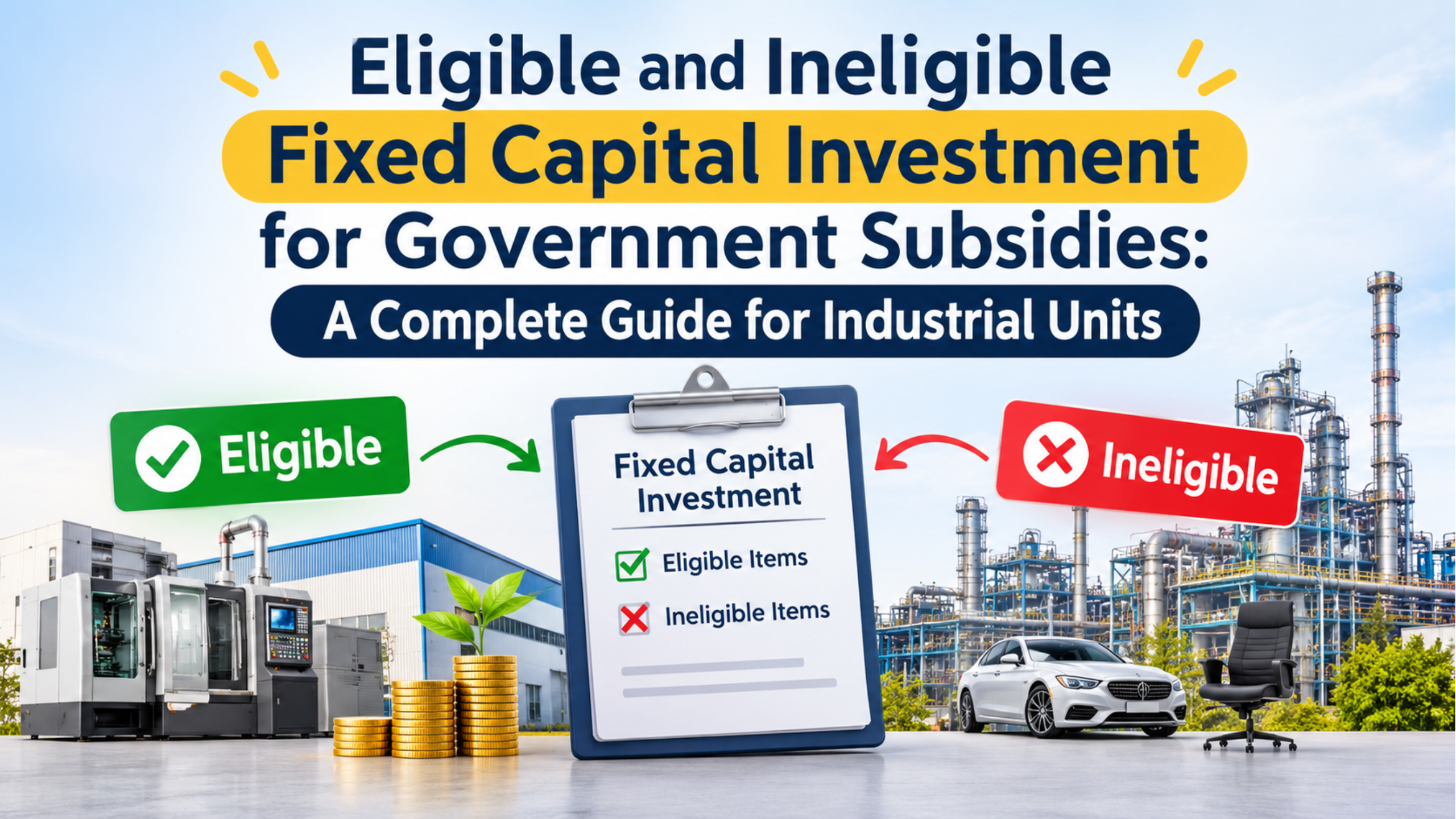
Eligible and Ineligible Fixed Capital Investment for Government Subsidies: A Complete Guide for Industrial Units

Eligible Fixed Capital Investment (FCI) generally includes new buildings, other eligible construction, new plant and machinery, and project-related infrastructure. Ineligible FCI generally includes land, working capital, goodwill and royalty, pre-operative expenses, second-hand machinery, capitalised interest and leased assets. Exact rules depend on the applicable Government Resolution (GR).
When setting up or expanding a manufacturing unit, knowing which investments qualify for subsidy is a core part of project planning. Under most industrial incentive schemes, assistance is calculated on eligible Fixed Capital Investment, but not every expense you incur counts. Identifying eligible and ineligible Fixed Capital Investment correctly is essential when preparing your Detailed Project Report (DPR), finalising project cost and planning a subsidy application.
In this guide, Dinesh J. Shah & Associates explains the major components of eligible and ineligible Fixed Capital Investment and what to check before you invest.
What Is Fixed Capital Investment (FCI)?
Fixed Capital Investment is the investment made in specified fixed assets to establish, expand, modernise, or diversify an industrial unit. Depending on the applicable policy, eligible FCI may include:
- New building construction
- Other eligible construction
- New plant and machinery
- Project-related infrastructure
Definitions and conditions differ between schemes, so always read the applicable GR and scheme guidelines before calculating eligible investment.
Eligible Fixed Capital Investment: What Qualifies?
The components below may qualify for consideration under applicable industrial incentive schemes, subject to the prescribed conditions.
New Building
A newly constructed industrial building used for eligible manufacturing activity may qualify. Example: a new factory shed built to house production machinery.
Other Construction
Certain construction expenses directly linked to the industrial project may be considered, depending on the policy. Check whether the scheme lists the specific construction types it accepts.
New Plant and Machinery
New plant and machinery needed for manufacturing is usually the largest component of eligible FCI. Example: new production lines, processing equipment, and other eligible manufacturing equipment.
Project-Related Infrastructure
Infrastructure developed specifically for the project may qualify under the scheme’s definitions and conditions. Check the scheme’s infrastructure definition before including it in your DPR.
Important: An expense in an eligible category does not automatically qualify. You must also examine its nature, purpose, ownership, payment proof, and compliance with the policy.
Ineligible Fixed Capital Investment: What Is Excluded?
Certain expenses are excluded when calculating eligible FCI under the scheme provisions.
Land and Land Development Cost
The purchase cost of land and land development expenses are generally excluded. Example: buying the plot for your factory.
Working Capital
Day-to-day operating needs are not FCI. Examples: raw materials, inventory, salaries and wages, electricity, and other routine expenses.
Goodwill and Royalty
Payments for goodwill and royalty are excluded under the stated criteria.
Preliminary and Pre-Operative Expenses
Costs incurred before commercial operations begin are excluded under the stated criteria.
Second-Hand Plant and Machinery
The cost of second-hand plant and machinery is excluded, whether bought domestically or imported. Example: a used CNC machine purchased from another unit.
Capitalised Interest
Interest on loans or borrowings capitalised into project cost is excluded.
Rented or Leased Assets
Assets acquired on rent or lease, including buildings, are excluded.
Power Generation Plant
Power generation facilities are generally excluded, except qualifying captive consumption facilities where the policy specifically permits.
Renewable Power Plants for Third-Party Sale or Non-Captive Use
Renewable power facilities built to sell electricity to third parties or for non-captive use are excluded.
Design, Drawing, Consultancy, Supervision and Third-Party Inspection Fees
These are excluded where they do not qualify under the scheme’s technology acquisition provisions. Always verify treatment against the relevant GR.
Eligible vs Ineligible Fixed Capital Investment: Quick Comparison Table
| Investment category | Status | What to check |
| New building | Eligible, subject to conditions | Used for eligible manufacturing activity |
| Other construction | Eligible, subject to conditions | Listed construction types in the GR |
| New plant and machinery | Eligible, subject to conditions | Must be new, with purchase invoices and payment proof |
| Project-related infrastructure | Eligible, subject to conditions | Scheme’s infrastructure definition |
| Land and land development | Ineligible | Keep outside the FCI claim |
| Working capital | Ineligible | Separate from fixed asset records |
| Goodwill and royalty | Ineligible | Exclude from project cost for subsidy |
| Preliminary and pre-operative expenses | Ineligible | Exclude from project cost for subsidy |
| Second-hand plant and machinery | Ineligible | Applies to domestic and imported |
| Capitalised interest | Ineligible | Exclude if capitalised into project cost |
| Rented or leased assets | Ineligible | Includes leased buildings |
| Power generation plant | Generally ineligible | Captive-use exception, if the policy allows |
| Renewable power plant (third-party or non-captive) | Ineligible | Check captive vs sale purpose |
| Design, consultancy and inspection fees | Ineligible unless qualifying technology acquisition | Check technology acquisition provisions |
Why Is Correct FCI Classification Important?
Classifying eligible and ineligible Fixed Capital Investment correctly helps in five ways:
- Accurate subsidy estimation: you see which investment may attract assistance.
- Proper DPR preparation: project cost is presented in a structured, transparent way.
- Better financial planning: you know eligible investment before finalising spend.
- Proper documentation: invoices, payment proofs, bank statements and asset records stay organised.
- Fewer application discrepancies: you avoid including expenses that don’t qualify.
Documents Required for Fixed Capital Investment Verification
Depending on the scheme and project, keep the following ready:
- Detailed Project Report (DPR) and project cost statement
- Building construction bills and invoices
- Plant and machinery purchase invoices
- Bank statements showing payments to suppliers
- Fixed asset register and machinery ledger
- Loan sanction letters and disbursement details, where applicable
- Technical details of machinery and project infrastructure
- Other declarations and certificates prescribed under the scheme
Maintaining these from day one reduces difficulty during application and verification.
Conclusion
Understanding eligible and ineligible Fixed Capital Investment is a key step before setting up or expanding an industrial unit. New buildings, eligible construction, new plant and machinery, and project-related infrastructure may qualify, while land, working capital, second-hand machinery, capitalised interest, and other excluded costs must be assessed separately. Planning a subsidy application? Speak to Dinesh J. Shah & Associates to classify your project cost correctly before you invest.
Frequently Asked Questions
What is Fixed Capital Investment (FCI)?
Fixed Capital Investment is the investment in specified fixed assets, such as buildings, plant and machinery, made to establish, expand, modernise or diversify an industrial unit. Subsidy is generally calculated on the eligible portion of FCI under the applicable government scheme.
Is land cost included in eligible Fixed Capital Investment?
Generally no. The purchase cost of land and land development expenses are excluded under the stated eligibility criteria. Confirm against the applicable GR for your scheme.
Is second-hand machinery eligible for subsidy?
No. The cost of second-hand plant and machinery, whether purchased domestically or imported, is excluded under the stated criteria. Only new plant and machinery generally qualifies.
Is working capital part of Fixed Capital Investment?
No. Raw materials, inventory, salaries, and routine operating expenses are working capital and are excluded from eligible FCI.
Does an eligible category guarantee subsidy?
No. Nature, purpose, ownership, payment proof, and policy compliance are also examined, so the expense must meet the scheme’s conditions.
Which documents are needed to verify eligible FCI?
Typically, the DPR, project cost statement, construction and machinery invoices, supplier payment bank statements, and fixed asset register, plus any scheme-specific declarations.